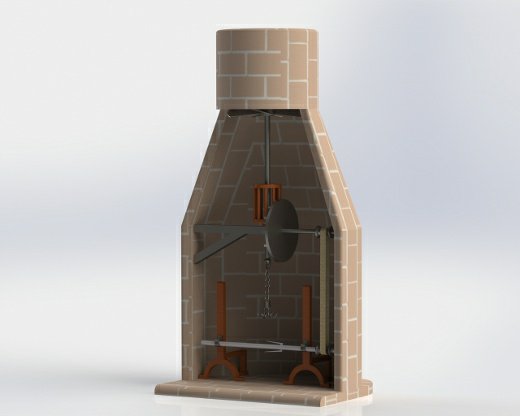

Working principle
Legend tells that Leonardo da Vinci manages several taverns in the Florentine area, even if there are no certain data.
Undoubtedly Leonardo was a great creator of convivial scenographies, therefore also of “machines” for banquets and for the kitchen. Many of his drawings served to illustrate the subjects of the theme that inspired the table (usually, as it was used after the mid-fifteenth century, of a mythological nature) or to make the shows that flanked it and inserted between the various courses.
We have received, by the Master, sketches of theatrical stages with winches and pulleys for the changes of scene, of millstones, of clothes and costumes for the “masquerades”, of large rotisseries.
Sheet 21 R of the Codex Atlanticus shows us two images of rotisseries designed by Leonardo: one operated by a counterweight, the other by the hot air raised by the fires and channeled through a rotation proportional to the intensity of the flames themselves.
This principle is truly extraordinary and fascinating, one of a kind!
Materials Used
The materials used are mainly 3: brickworks, raw iron (already used and forged in Florence), wood (to be precise Oak, very resistant and widely widespread in Tuscany).
Model Components
Structure of the Cooker Hood with Brackets, Big Fan, Vertical Axis, Rotating Cage, Cogwheel, Pulleys and Belt (for the motion trasmission between the two shafts), Rotating Skewer, Eases, Harpoon Chain


